Top Liquidity Agencies in Crypto: Guide for 2026

Every week new tokens launch. Most of them share the same quiet problem: nobody can actually trade them without moving the price.Not because the project is bad. Not because the community isn't there. But because the order book is empty the spreads are embarrassing and the first time a real buyer shows up with size the chart does something that scares everyone else away. This guide is about the firms that solve that problem how they differ from each other and what a token project or exchange actually needs to think about when choosing one.
What a Liquidity Provider Actually Does
The term gets used loosely, so it's worth being precise.
A crypto liquidity provider continuously places buy and sell orders on exchanges - both centralized (CEX) and decentralized (DEX) - to ensure that traders can execute without massive price impact. The gap between the best buy and sell price at any moment is the bid-ask spread. The wider that gap, the worse the experience for every participant in the market.
A professional liquidity agency narrows that spread, adds depth across price bands and manages inventory so the market stays functional even during volatile periods. Done well it's invisible. Done poorly, it becomes the reason a token's chart never looks investable.
Why This Matters More Than Ever in 2026
The market has matured significantly. Institutional participants now account for a meaningful share of crypto volume, and they apply the same execution quality standards they use in traditional finance. A token with a 3% spread on its primary listing doesn't get added to an institutional portfolio, it gets passed over.
At the same time, the number of token launches has increased sharply. According to BeInCrypto's 2026 institutional research, more than 30 firms were screened for their liquidity provider category this year, up significantly from previous cycles. The supply of providers has grown, but so has the sophistication required to evaluate them. For projects in particular, the stakes have shifted. Getting listed is no longer the hard part. Maintaining a market that looks credible to the next wave of buyers - that's where most projects struggle.
The Two Types of Projects That Need This
Before getting into the agencies themselves, it's worth separating the two very different audiences in this market.
Institutional clients - exchanges, hedge funds, large protocols - need deep liquidity at scale, regulatory compliance, and infrastructure that can handle billions in daily volume without errors. They're evaluating firms like Wintermute or GSR, and the conversation is about API connectivity, settlement frameworks, and counterparty risk.
Token projects - teams who have launched or are about to launch a token - need something different. They need a partner who understands chart health, investor perception, the dynamics of a token launch, and how to grow organic trading volume over time. Their budget is different, their timelines are different, and frankly, their risks are different.
The Major Players: Institutions First
BeLiquid
BeLiquid sits in a specific and underserved segment: token projects that need more than just volume, but a genuine partner in market health. The agency works across 100+ CEX and DEX platforms with 24/7 coverage, and focuses on what most liquidity providers ignore the relationship between chart shape and investor confidence. Their programs are designed around distinct project challenges rather than a one-size model:
Smart Buy-Back - token recovery programs designed to improve price structure with minimal treasury spend. Attractive Chart - liquidity strategy focused on creating an investor-friendly price environment that encourages organic participation. Profit Generation - trade-driven revenue programs that generate returns through strategic execution. IEO Price Protection - stabilisation infrastructure specifically designed for launch windows, where first impressions define long-term trajectory.
The result of this approach is measurable. In one documented case study, a project partnering with BeLiquid saw organic trades grow from 3% to 46% of total volume within budget and within the planned timeframe. That shift - from supported to organic is what separates a project with real market traction from one that's permanently dependent on artificial volume.
For teams trying to understand the mechanics behind these programs - how market making works, what spreads actually mean, and what to look for in a liquidity partner - the BeLiquid is a useful starting point before any conversation with a provider.
Wintermute
Wintermute is the largest crypto-native algorithmic market maker by most measures. They trade more than $5 billion daily across hundreds of tokens on 50+ exchanges, and their OTC desk grew over 300% year-over-year in 2025. Their 2024 single-day OTC spot volume record was $2.24 billion. They operate across both CEX and DEX, run a venture arm that has invested in 100+ projects, and built their own DEX (Bebop). Clients include Solana, Binance, Aave, Optimism, and Starknet.
Best for: Large exchanges and well-capitalised protocols that need institutional-grade liquidity infrastructure and don't require hand-holding. Not ideal for: Early-stage token projects with limited budgets or teams that need active strategy consultation.
GSR
Founded in 2013, GSR is one of the most credentialed firms in the space. In 2025 they acquired Equilibrium Capital Services, an SEC-registered broker-dealer, expanding their regulated U.S. operations. Their GSR One platform unifies market making, OTC trading, and treasury management under one roof. Clients include Ripple, Ethena Labs, Sei, EtherFi, and Kiln. GSR is active on 60+ exchanges globally and is widely considered the benchmark for compliance-first institutional counterparties.
Best for: Projects and institutions where regulatory clarity is a hard requirement. Not ideal for: Projects that need flexible, growth-oriented liquidity strategies at accessible price points.
Keyrock
Keyrock reached a $1.1 billion valuation in 2026 following a Series C. Belgium-based and founded in 2017, they operate across 85+ venues with a fully algorithmic, delta-neutral approach. In 2025 they expanded to the U.S. and acquired Turing Capital to launch an asset management division. Deutsche Bank and Societe Generale are among their institutional partners.
Best for: EU-regulated projects and institutions that want quant-driven precision across a wide venue footprint. Not ideal for: Smaller projects that need a more hands-on, consultative partner.
DWF Labs
One of the most active market makers by raw volume - trading across 60+ exchanges with over 1,000 project relationships. DWF combines algorithmic liquidity provision with strategic investment, making them a dual presence as both a market maker and a Web3 investor. Their infrastructure delivers over 95% uptime with OTC solutions across 50+ assets.
Best for: Projects looking for a combined market making and investment relationship. Approach: High-volume, broad coverage.
Agencies Built for Token Projects
The firms above are built for scale. But most token projects don't need $5 billion in daily volume infrastructure, they need a partner who understands their stage, their community, and the specific dynamics of growing a token market from near-zero.
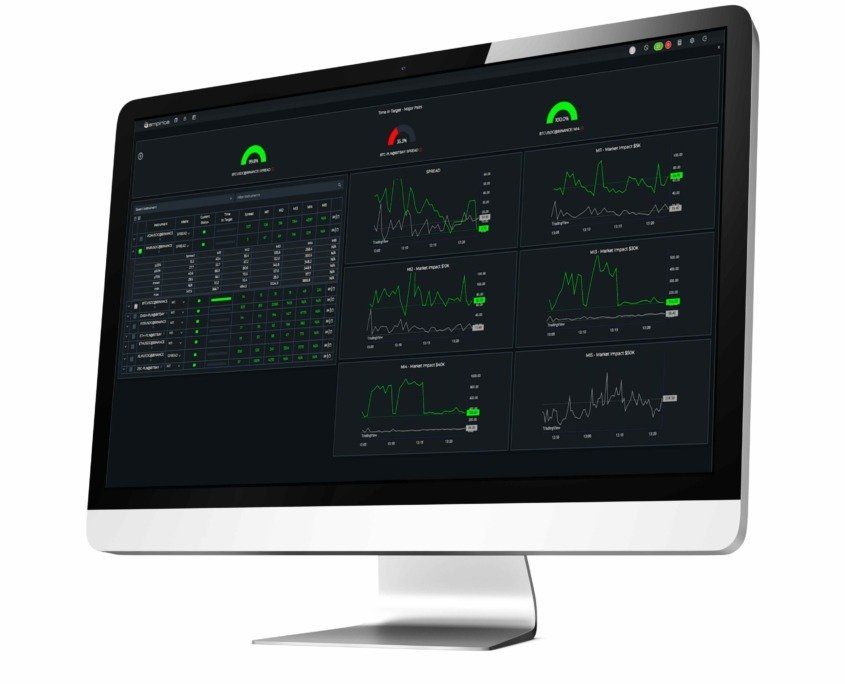
Kairon Labs
Recognised for customised strategies for token projects, including IEO support, token launch preparation, and sustained liquidity campaigns. Known for working closely with project teams rather than operating at arms length.
How to Actually Choose a Provider
The honest answer is that most token projects ask the wrong questions. Volume figures and exchange counts are easy to inflate and hard to verify. Here's what actually matters:
Do they measure organic participation? Any provider can show you total volume. The relevant question is what percentage of that volume came from real market participants who showed up without being incentivised. If a provider can't answer that question, they're probably not tracking it.
What does their reporting look like? Screenshots of green candles are not reporting. Post-period summaries should include realised spread, depth by price band, slippage for standard clip sizes, and how the supply curve evolved. Projects with serious investors will eventually be asked these questions - make sure your provider can help you answer them.
Do they have experience with your specific challenge? A firm that specialises in institutional OTC flows has very different expertise from one that has run 50 token launches. Make sure the experience is relevant, not just impressive-sounding.
What happens at 3am on a Sunday? Markets don't keep business hours. A liquidity provider without genuine 24/7 coverage is a provider who will be absent exactly when you need them most - during the volatility events that define how your token is perceived.
Is there a conflict of interest in their model? Some providers hold significant token positions as part of their compensation. That creates incentives that aren't always aligned with the project's long-term health. Understand the model before signing anything.
A Quick Reference
For institutional needs (exchanges, large protocols, hedge funds): Wintermute, GSR, Keyrock, DWF Labs are the established players, each with different strengths in terms of regulatory posture, venue coverage, and approach.
For token projects at launch or growth stage: BeLiquid, Kairon Labs offer more accessible, strategy-driven partnerships focused on chart health and organic growth rather than raw volume.
For projects evaluating their options, the BeInCrypto Institutional 100 methodology - which assesses firms across daily volume, venue connectivity, regulatory licensure, and settlement frameworks - is one of the more rigorous public frameworks available.
The Bottom Line
Liquidity isn't a feature you add after launch. It's infrastructure that needs to be in place before the first real buyer shows up with size. The firms in this guide represent different approaches to the same underlying problem: markets need two-sided depth to function, and that depth doesn't appear by itself. Which one makes sense for a given project depends almost entirely on what stage the project is at, what problem it's actually trying to solve, and whether it needs institutional scale or project-stage partnership. The worst outcome is choosing a provider based on name recognition, finding out they weren't built for your situation, and spending three months trying to fix a market that nobody bothered to design properly in the first place.
BeLiquid designs and executes liquidity strategies for token projects across CEX and DEX venues. Show us your chart - we'll build a practical plan aligned with your tokenomics and treasury constraints.