Crypto Market Making in 2026

1. Introduction: Why Liquidity Became the New Marketing
In the early years of crypto, a project could launch with a white paper and a Telegram group and still hit a 10× on day one. Those days are over. In 2026, institutional participants, sophisticated retail traders, and AI-driven arbitrage bots share the same order books. The competition is algorithmic, and the bar for a "successful launch" has been radically redefined.
Today, a successful launch isn't just about a high price on day one. A project's real success depends on liquidity - how easy it is to buy and sell - and on long-term trust, which is built through transparent, professional market behaviour. While hype can cause a quick price jump, only solid preparation prevents a crash.
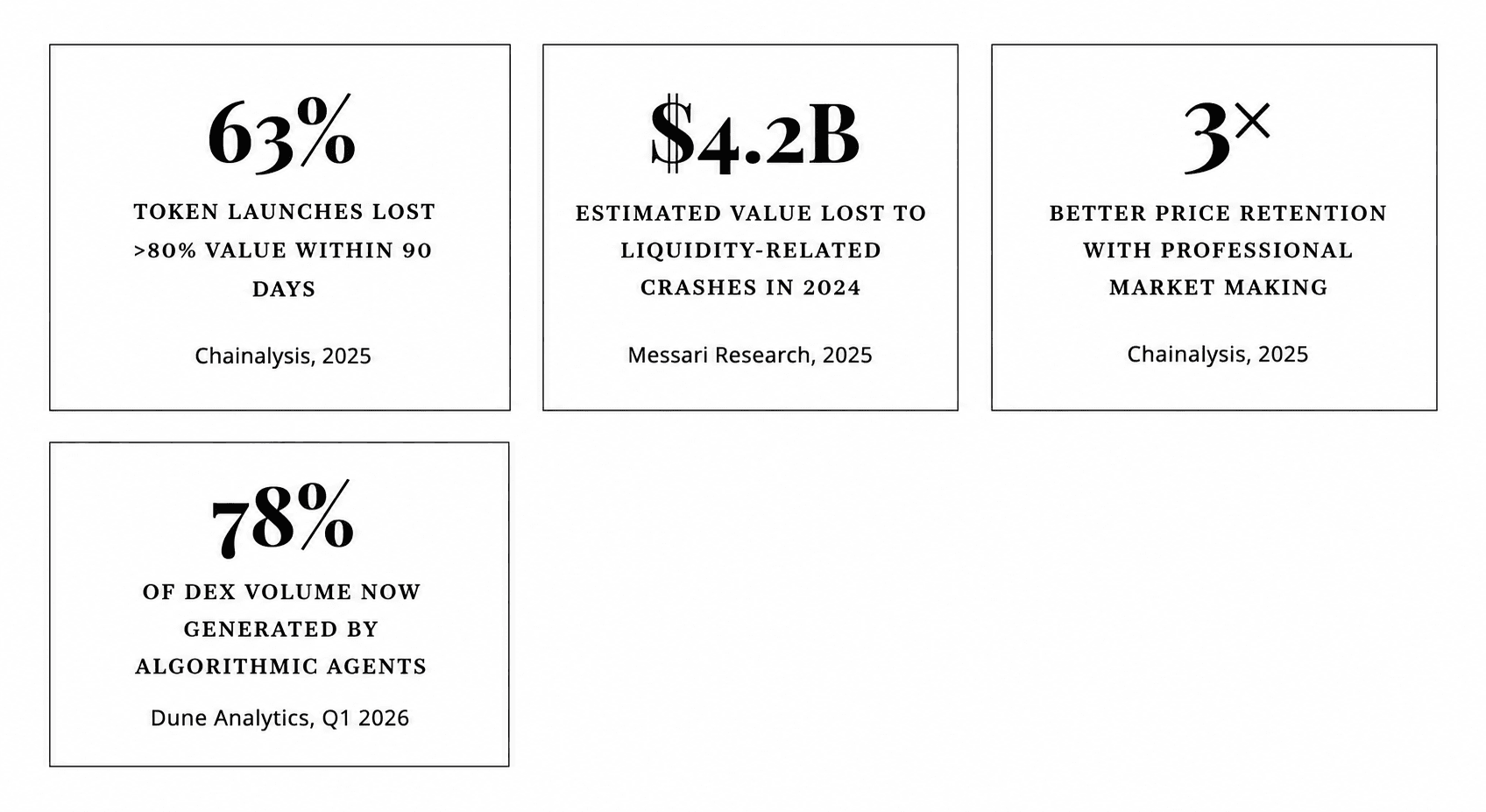
According to a 2025 report by Chainalysis, over 60% of new token launches in 2024 lost more than 80% of their opening-day value within 90 days - primarily due to poor liquidity planning rather than flawed technology. Meanwhile, projects with professional market-making support showed median price retention of 3× higher over the same window.
This guide explains the fundamental rules for a professional token launch, drawing on current research and practical methodology developed at BeLiquid. The focus is on Market Health as a strategic asset - not just a technical consideration.
2. The Rise of Autonomous Market-Making Agents
The crypto market in 2026 operates in a fundamentally different environment than even three years ago. Autonomous AI agents - software systems that monitor order books, execute trades, and adjust strategies in real time without human intervention - now account for a significant majority of trading volume across both centralised and decentralised venues.
A landmark analysis from Dune Analytics found that in Q1 2026, algorithmic agents were responsible for approximately 78% of all DEX transaction volume. On major CEXs like Binance and OKX, that figure is believed to be even higher.
The market microstructure of crypto assets in 2026 is essentially a competition between AI systems. Projects that don't understand this dynamic are playing chess while everyone else plays a different game entirely. Dr. Tao Wu, Head of Quantitative Research, Kaiko Data, 2025 Annual Report
How Autonomous Agents Work
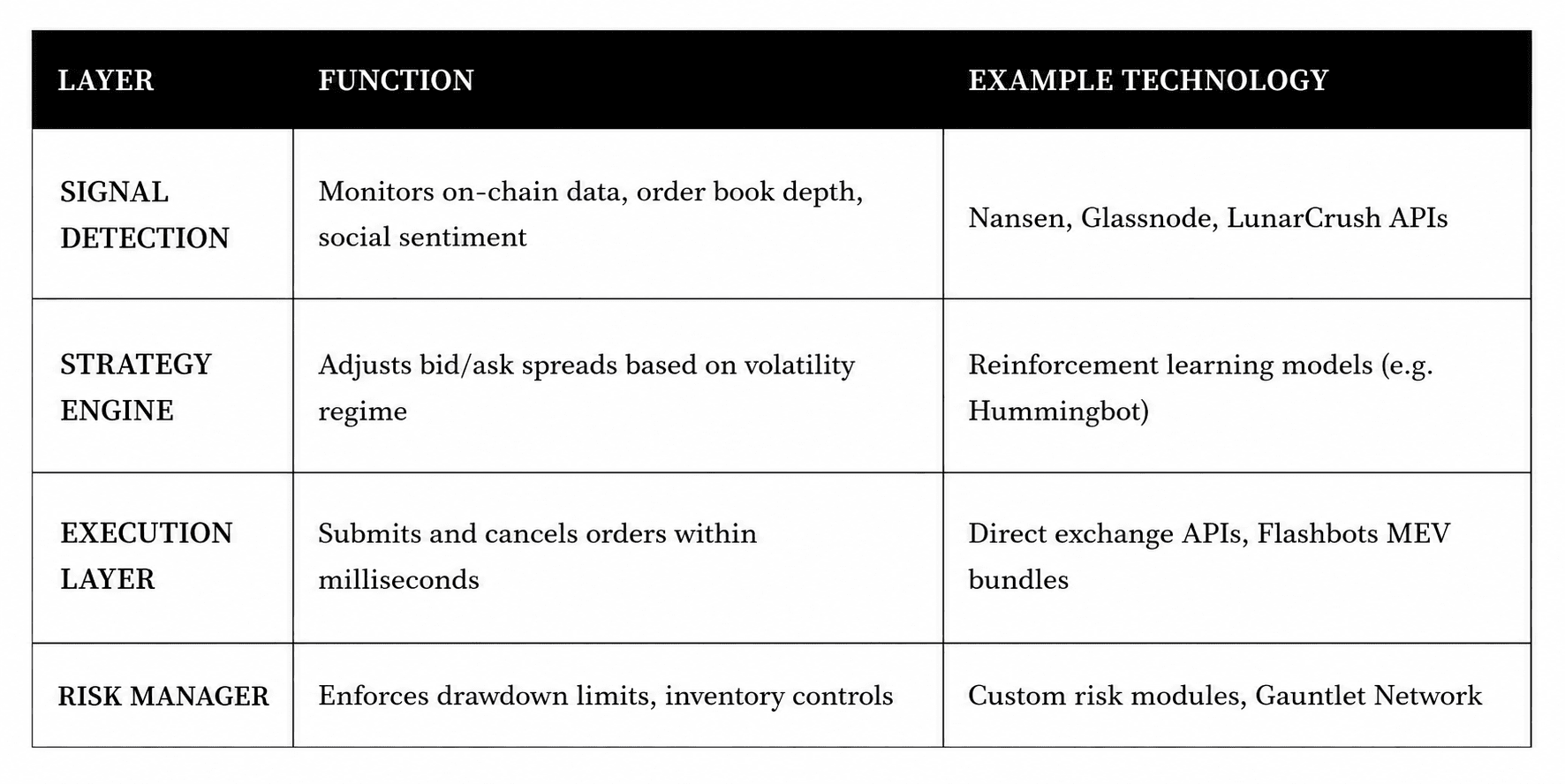
For a new token project, this environment has two implications. First, without proper liquidity design, bots will rapidly exploit any thin order book - widening spreads, triggering cascading sells, and destroying price discovery. Second, and more positively, projects that do deploy sophisticated market-making support can benefit from the same algorithmic infrastructure that harms the unprepared.
Open-source frameworks like Hummingbot and research from Paradigm have made algorithmic market-making more accessible - but expertise in configuring these systems for a specific token's launch parameters remains specialised work.
3. Is the Market Ready for You? Pre-Launch Diagnostics
One of the most common and costly mistakes in token launches is treating the launch date as fixed and working backwards from it, rather than treating it as a variable determined by market conditions. Before you pick a date, evaluate the following factors with data - not sentiment.
Platform Depth
Examine trading activity in comparable projects currently listed on your target exchange. Tools like CoinGecko and CoinMarketCap provide 24-hour volume data, but for deeper analysis, platforms like Kaiko offer granular order book data to assess real depth. A thin market means even modest sell pressure can cause outsized price drops.
Macro Volatility Check
If BTC or ETH are experiencing swings greater than 15% within a 7-day window, launching in that environment carries substantial risk. High volatility activates defensive algorithms in market makers across the ecosystem, widening spreads everywhere and reducing the liquidity available to new listings. The CoinGlass Long/Short Ratio is a useful real-time indicator of market sentiment.
Key Diagnostic: Run a stress test before launch. Simulate what happens to your token price if $100,000 of sell orders hit in a single hour on day one. If your model shows more than a 10% price drop, your liquidity provision is insufficient.
Revenue Independence Test
This is the hardest check but the most important. Your project needs a revenue model that does not depend on selling tokens to your community to fund operations in the first 90 days post-launch. Projects that rely on token sales to pay infrastructure costs, salaries, or marketing in month one are structurally fragile. Investors in 2026 can read treasury wallets on-chain - and they do.
Research from Messari shows that projects with at least 6 months of non-token operating runway at launch have a 2.4× higher probability of still being actively traded 12 months later.
4. The Triple Plan: Scenario-Based Liquidity Strategy
The market doesn't follow your roadmap. Professional liquidity management requires planning for multiple scenarios simultaneously - not optimistically assuming the best case. At BeLiquid, we use a Triple Plan framework, adapted from risk management practices used in traditional financial markets.
Plan A - The Normal Plan
Under normal trading conditions, the goal is smooth price discovery with tight spreads. Professional market makers target bid-ask spreads of 0.1% to 0.5% for most mid-cap tokens. This range is tight enough to attract real traders without exposing the market maker to excessive inventory risk. For reference, even Binance's top tokens often trade with spreads in the 0.05–0.1% range, so your target will depend on volume.
Plan B - The Defensive Plan
If a wave of sell orders begins - whether from a whale exit, a coordinated short attack, or negative news - a pre-defined defensive response needs to activate automatically. This typically involves:
- Placing tiered support orders at 5%, 10%, and 15% below current price
- Temporarily widening spreads to reduce exposure
- Activating circuit-breaker logic to pause aggressive quoting if volume spikes beyond 3× the 24-hour average
This is where the human element remains critical. Automated systems can execute Plan B, but a human needs to be authorised to override them. Decide before launch who has 3 AM decision-making authority.
Plan C - The Pause Plan
Black swan events - exchange hacks, regulatory announcements, macro shocks - can make any launch untenable regardless of preparation. Having a documented, pre-agreed process for delaying a launch is not a sign of weakness; it's a sign of maturity. Communicate this possibility to your community in advance so a delay doesn't itself become a trust-destroying event.
"The best launch is one that happens at the right time, not the scheduled time. Every week of delay is worth less than one week of catastrophic first-day performance." Kyle Samani, Managing Partner, Multicoin Capital, 2025 LP Letter_
5. Giving the Token Real Purpose
The era of governance tokens with no governance, and utility tokens with no utility, is over. Institutional capital - which now represents a significant portion of legitimate crypto investment - applies rigorous frameworks before allocating to any token. The regulatory environment in most major jurisdictions has also tightened significantly since 2023, making clear utility not just commercially valuable but legally important.
Transparency as a Trust Signal
Publish a complete, auditable tokenomics document before launch. This should include: total supply, allocation breakdown (team, investors, treasury, public), vesting schedules for all locked tranches, and a clear description of what the token actually does within your product. Platforms like Tokenomics.io and CoinGecko's tokenomics section have made it trivially easy for researchers to compare your project against peers.
Liquidity Pool Sizing
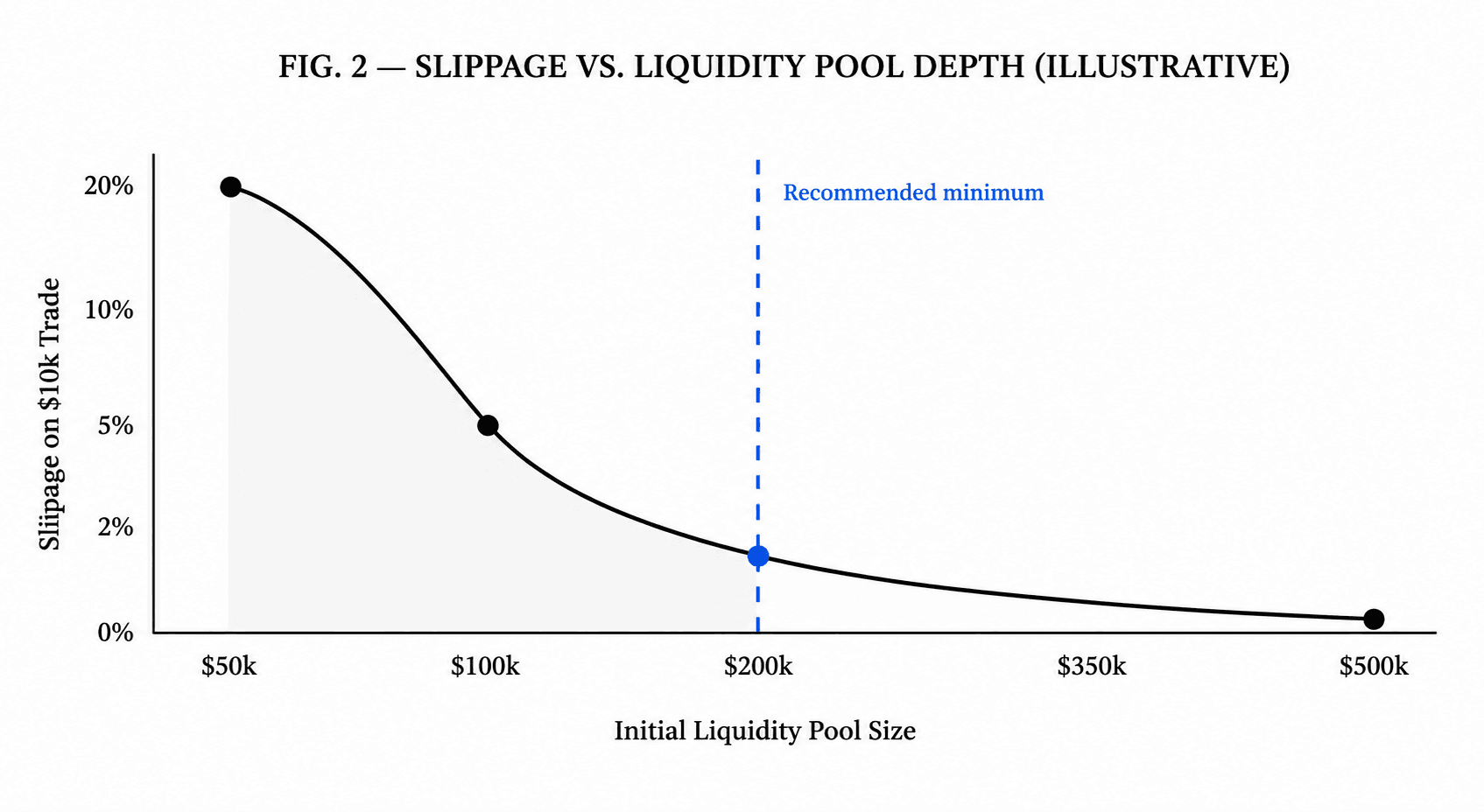
For a new token, a common benchmark for DEX launch liquidity is to seed the initial pool with enough capital that a 1% price impact requires at least $10,000 of trading volume. For most projects, this means initial liquidity of $200,000–$500,000 minimum. Below this threshold, the token is mechanically vulnerable to manipulation.
The formula used by professional market makers is derived from Uniswap V3's concentrated liquidity model, and detailed documentation is available in the Uniswap V3 technical documentation.
6. Professional Market Management Principles
Trust comes from a chart that looks stable and professionally managed. This is not about manipulation - it's about providing the infrastructure that allows genuine buyers and sellers to transact efficiently. The distinction matters both ethically and legally.
Always Having a Buyer (Bid Support)
At any given moment, there should be a resting bid order in the book - someone algorithmically willing to buy if a seller appears. This is the foundational function of a market maker. Without it, sudden sells cause gap-downs in price that are functionally impossible to recover from quickly, and that destroy retail investor confidence.
Cross-Exchange Price Consistency
If your token is listed on multiple venues - common for tokens with both CEX and DEX presence - price discrepancies between markets invite arbitrage bots to extract value from the spread. Professional market management includes cross-venue price harmonisation: keeping bid/ask midpoints within 0.2% of each other across all exchanges. Binance's Market Maker Program documentation provides useful benchmarks for CEX expectations.
The $50k Resilience Test
A professionally managed token market should be able to absorb a $50,000 market sell order with less than 2% price impact. This is a practical benchmark used by institutional investors when assessing whether a token is "investable." Below this threshold, a token is typically categorised as a micro-cap with high manipulation risk, which excludes it from consideration by a significant portion of capital.
Practical Rule: Never launch a token with less than 3× the liquidity you think you need. Market stress events always occur, and they always hit harder than modelled.
Avoiding Wash Trading
The temptation to inflate volume figures with wash trades - simultaneous buy and sell orders by the same entity - is understandable but self-defeating. Detection tools like Nansen, Chainalysis, and exchange-internal surveillance systems have become highly accurate. Projects caught wash trading face exchange delistings, reputational collapse, and in multiple jurisdictions, legal prosecution. Build real volume through real users.
7. Case Study: What Bad Liquidity Looks Like
Without naming specific projects, a composite picture from 2024's documented liquidity failures is instructive. In a typical poorly-managed launch:
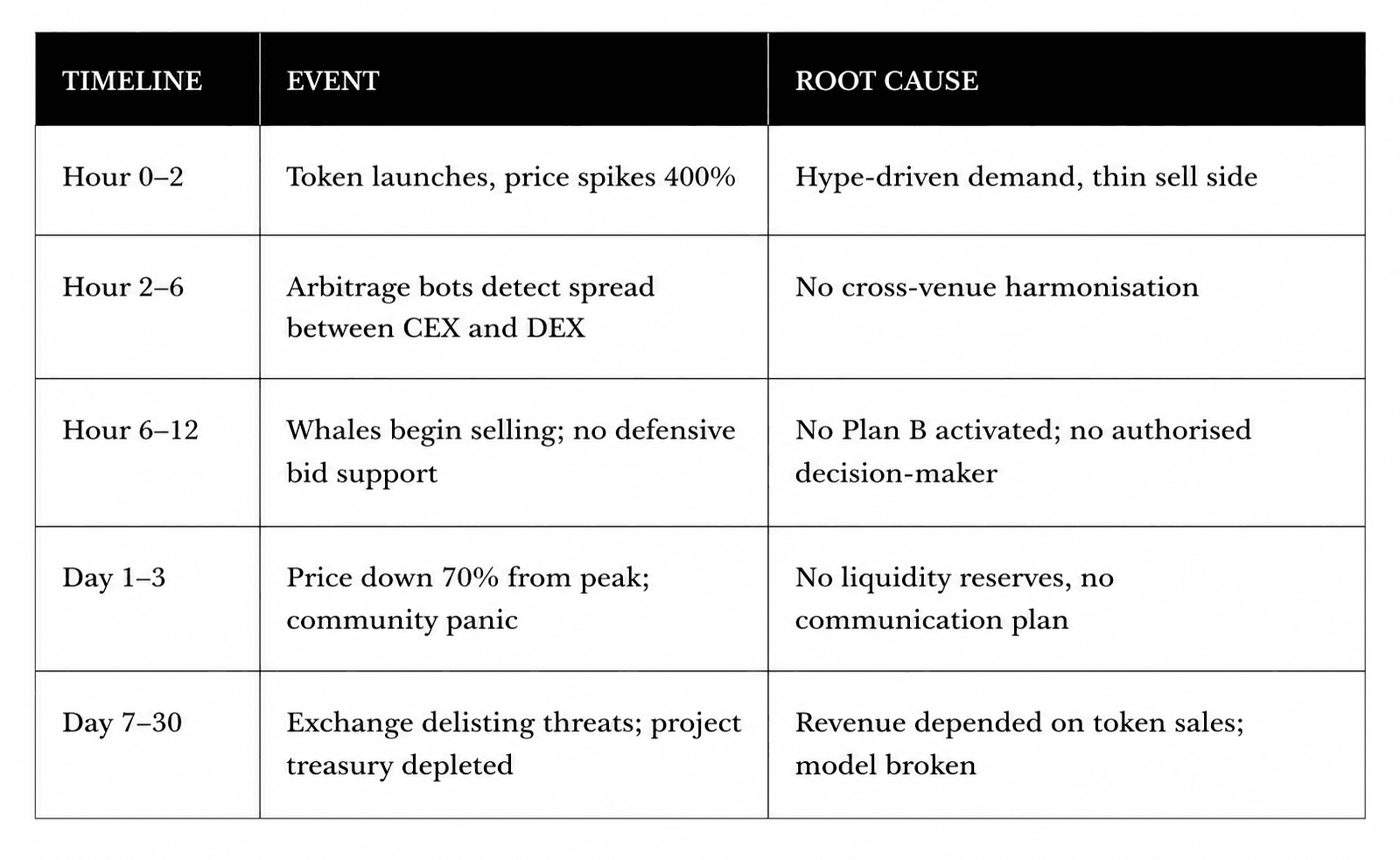
Each of these failure modes was preventable. None required extraordinary resources - they required planning, process, and the right partners.
For further reading on liquidity failure patterns, the academic literature is useful: a 2024 paper by Aquilina, Budish & O'Neill (SSRN) documents how market structure fragility in crypto directly mirrors historical patterns in equity microstructure before regulatory reform.
8. Conclusion: Build to Last
The days of "launch and hope" are definitively over. The crypto market of 2026 is a sophisticated, algorithm-driven environment where professional preparation is not optional - it is the baseline for survival. Long-term success comes from the intersection of good technology, a genuine product with revenue independence, and professional market management executed from day one.
The checklist is not short, but it is achievable:
- Pre-launch market readiness assessment (depth, macro, revenue)
- Triple Plan documentation with named decision-makers
- Tokenomics published and audited before launch
- Liquidity pool adequately sized for $50k resilience
- Cross-venue price management in place
- Bid support algorithm active from first second of trading
- No wash trading, ever
Projects that get this right don't just survive - they build the credibility that attracts the next round of institutional interest, the next exchange listing, and the next cohort of genuine users.
Work with BeLiquid - Trusted by 500+ Projects
Don't leave your project's future to luck. BeLiquid is one of the most experienced market-making agencies in the space - with over 500 token projects supported across more than 100 CEX and DEX platforms, including Binance, MEXC, and Bybit. Our proprietary algorithms run 24/7, maintaining tight spreads, defending against bot attacks, and keeping your token price consistent across every venue simultaneously. While most projects scramble to find liquidity after launch, BeLiquid clients go live with infrastructure already in place - from the very first second of trading. Whether you're preparing for a TGE, seeking a new listing, or stabilising an existing market, our team has seen it before and knows exactly what to do.